Tokenomics and Issuance Curve
EXFER, the chain's native unit, enters circulation only through mining — no premine, no ICO, no VC allocation, no team reserve. Block reward decays exponentially and stabilizes at 1 EXFER per block.
The issuance formula
Block reward at height h:
reward(h) = max(MIN_REWARD, INITIAL_REWARD * exp(-ln(2) * h / HALF_LIFE))
with:
| Constant | Value |
|---|---|
INITIAL_REWARD | 100 EXFER |
MIN_REWARD | 1 EXFER |
HALF_LIFE | 6,307,200 blocks (~2 years) |
| Target block time | 10 seconds |
Reward halves every two years — from 100 EXFER at genesis to 50 at year two, and so on — until it reaches the permanent 1 EXFER floor around year 13.
Decay schedule
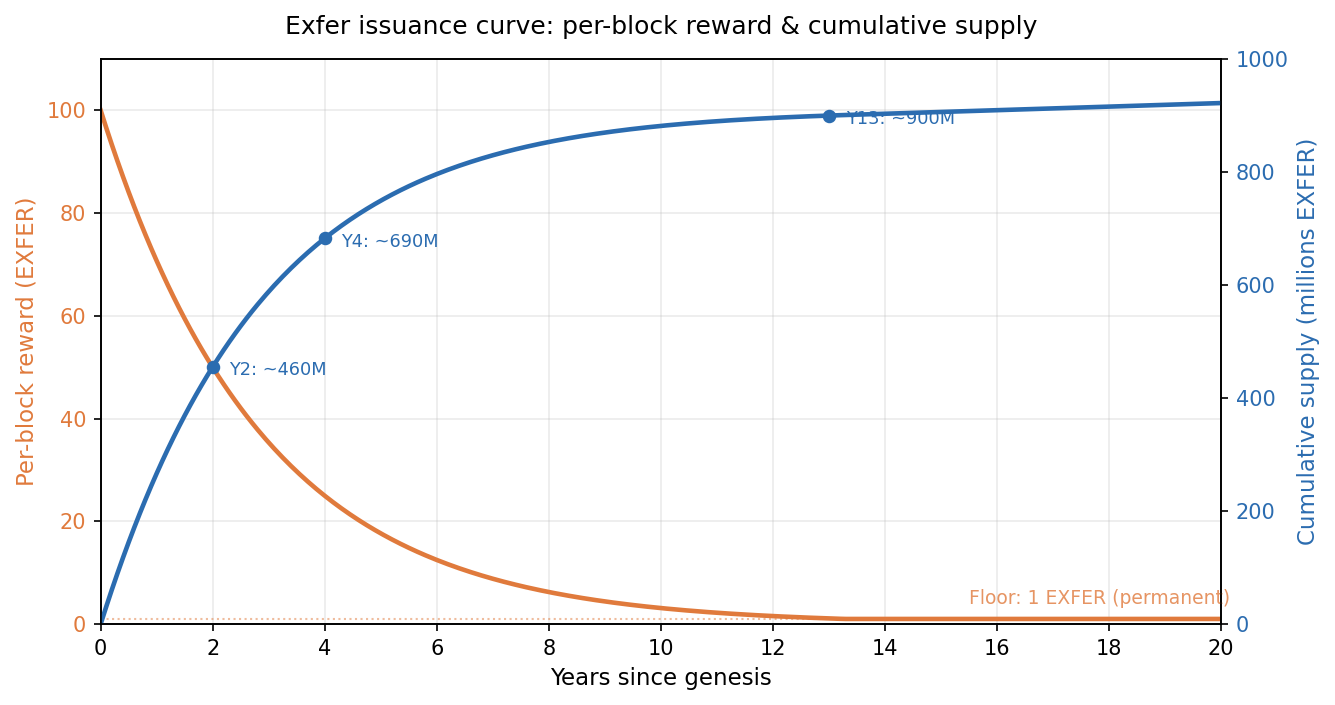
Orange (left axis): per-block reward decays exponentially from 100 EXFER, hitting the permanent 1 EXFER floor around year 13. Blue (right axis): cumulative supply — 90% emits in the first 13 years, then grows linearly at 1 EXFER per block forever.
In wall-clock terms (~10s/block, 6,307,200 blocks ≈ 2 years):
| Year | Reward / block | Cumulative supply (approx.) |
|---|---|---|
| Genesis | 100 EXFER | 0 |
| Y1 | ~71 EXFER | ~270M EXFER |
| Y2 | 50 EXFER | ~460M EXFER |
| Y4 | 25 EXFER | ~690M EXFER |
| Y8 | 6.25 EXFER | ~860M EXFER |
| Y13.3+ | 1 EXFER (permanent floor) | ~900M EXFER |
| Y20 | 1 EXFER | ~922M EXFER |
| Y50 | 1 EXFER | ~1.02B EXFER |
Numbers are approximate (actuals depend on real block-time variance under difficulty adjustment), but the shape is fixed: 90% of supply emits in the first 13 years, then linear growth of 1 EXFER/block (~3.15M EXFER/year) forever.
What the permanent 1 EXFER buys
After Bitcoin's last block in 2140, miners are paid only from transaction fees — there's an open concern that fee revenue alone may not sustain the security budget. Exfer's permanent 1 EXFER floor is the cushion: regardless of fee market conditions, miners always have a baseline subsidy keeping hash power on the network. Monero's "tail emission" implements the same idea differently.
Long-term inflation rate
| Period | Annualized inflation | Comparable to |
|---|---|---|
| Y1 → Y2 | Very high (bootstrapping window) | Like Bitcoin's first year |
| Y3 → Y4 | ~15% | Similar to Ethereum during PoW |
| Y5 → Y10 | ~5% / year average | Typical PoS chains |
| Y20+ | < 0.4% / year | Lower than gold (~1.5%) |
What "no premine / no VC" means
The protocol specification (Genesis chapter) and source code confirm:
- The genesis block allocates zero coins to team, VC, or foundation
- No premine: every EXFER must be mined
- No ICO / IDO / IEO: the project accepted no early funding round
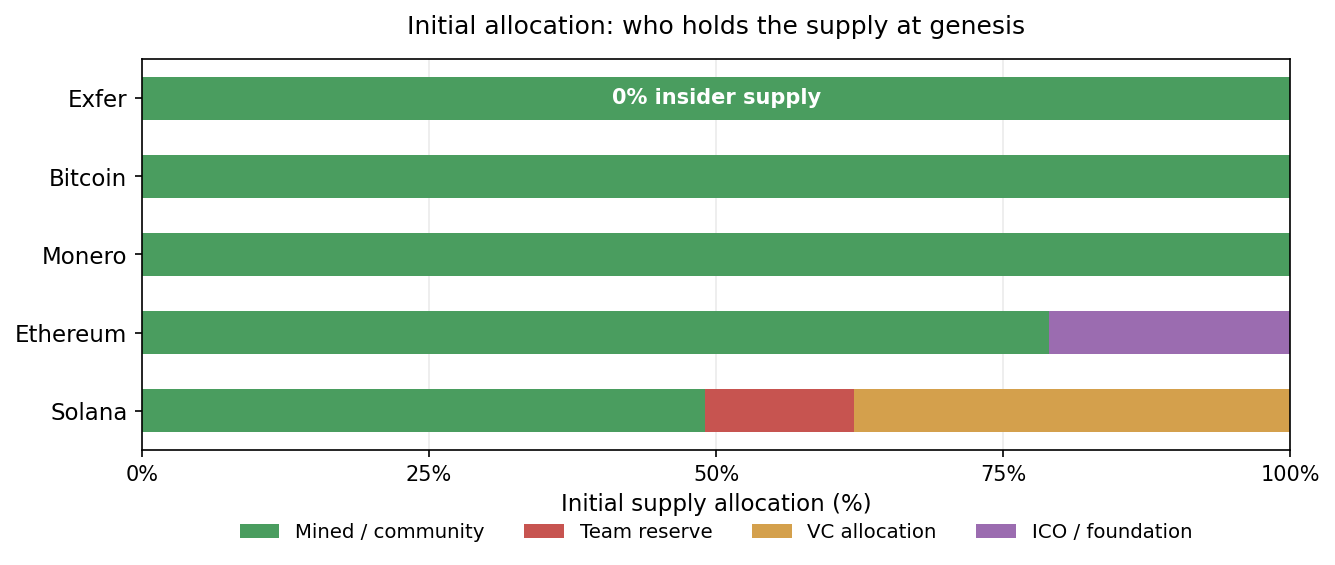
For comparison, early allocations across major chains:
| Project | Early allocation (team / VC / foundation) |
|---|---|
| Exfer, Bitcoin, Monero | 0% |
| Ethereum | 12% premine to ICO + 9% to foundation |
| Solana | 38% to VC + 13% to team |
| Most post-2020 launches | 30–50% |
What this means in practice: there are no insider supplies waiting to unlock and dump on the market. The cost is that the project has no marketing war chest, no exchange-listing budget, no PR. Awareness in the mainstream is near zero; distribution has to grow organically through community. This matches the profile of Bitcoin and Monero — "clean PoW" launches, a category that has nearly disappeared since 2020.
Costs / boundaries
- Front-loaded distribution. Nearly half of total supply emits in the first two years, rewarding the earliest miners. Whether this qualifies as a "fair launch" depends on the definition you use
- Lower absolute hash rate than SHA-256 chains. Lower total value + memory-hard PoW = fewer attempts per watt of energy. The dollar cost of a 51% attack is lower in absolute terms, though comparable as a fraction of market value
- No protocol-level fee mechanism (e.g. EIP-1559). Exfer has no "burn a portion of fees" deflationary mechanism; all transaction fees go to miners
- No team treasury = no official marketing budget. Ecosystem growth depends entirely on community pace — slow, but with a clean path
Further reading
- How Exfer mining works — how the issuance curve lands on the mining side
- Protocol specification §11 — exact formula
- FAQ / Is there a token sale — short version
- Status and how to verify yourself — how to independently confirm "no premine"